
Banking on better credit growth prospects alone may not be the right strategy as far as investing in bank stocks are concerned.

"We will raise Rs 300 crore via bonds of two-, three- and five-year tenures. This will be our maiden bond issuance and is part of our effort to widen funding sources," says Vimal Bhandari, executive vice-chairman and chief executive officer (CEO), Arka Fincap. The firm, a subsidiary of Kirloskar Oil, is only five years old and small (assets of around Rs 5,000 crore with an "AA" rating), but the response to this float will be closely watched: It would be the first by a non-banking finance company (NBFC) after Mint Road upped the risk weights on bank exposures to them by 25 percentage points. The move by the Reserve Bank of India (RBI) has caught NBFCs off guard even though the issue had been flagged by Governor Shaktikanta Das with their corner-room occupants (and that of banks) in July and August 2023 - on consumer credit and the dependency on bank borrowings.

'He's at best a holding-CEO. Not one who will re-imagine the bank,' a senior banker and former colleague tells Raghu Mohan about HDFC Bank CEO & MD Sashidhar Jagdishan.

The finance ministry expects a broad-based moderation in inflationary pressures on the back of an anticipated reduction in food prices as a result of the uptick in summer sowing. The retail inflation rate remained stubbornly clung to the 5 per cent mark in seven of the past eight months. "Core inflation is trending downwards, indicating a broad-based moderation in price pressures... Driven by strong domestic growth and benign global commodity prices, core inflation is declining continuously.

Ranveer Singh, Kriti Sanon and Manish Malhotra visited the Kashi Vishwanath temple in Varanasi to offer prayers over the weekend.

'The focus needs to shift towards the ability to collect payments, particularly in tier-3 to tier-4 areas where acceptance is still lacking.'

Banks now ride on what is defined as a "banking outlet". This is a fixed-point service unit, manned by either the bank's staff or its business correspondent (BC), where all kinds of services - acceptance of deposits, encashment of cheques, cash withdrawal or lending of money - are provided for a minimum of four hours per day, for at least five days a week. Banks are now turning to reposition the manner in which they acquire customers, report Abhijit Lele and Raghu Mohan.
Surging stock markets have helped 11 banks to garner a whopping Rs 11,067 crore (Rs 110.67 billion) to meet their capital requirements during 2005-06.

'The last year's growth is a foretaste of things to come in the retail credit market.'

'We may bite the bullet and draw up plans for privatisation.' 'If that is done now, the sale of the government stake will fetch money; a delay will see erosion in whatever value is left in these banks,' says Tamal Bandyopadhyay.

The government scheme has a long way to go before its ultimate goals of universal financial inclusion and financial literacy are achieved.

Banks feel happy shifting their toxic assets from loan books to investment books while the ARCs enjoy the management fees with a smile, observes Tamal Bandyopadhyay.

Public sector banks accounted for a bulk of frauds reported in 2018-19 -- 55.4 per cent of the number of cases reported and 90.2 per cent of the amount involved -- mainly reflecting the lack of adequate internal processes, people and systems to tackle operational risks, the RBI report said.
In FY23, the State Bank of India (SBI) reported a 57.4 per cent jump in its net profit to Rs 55,684.17 crore. But the chairman of the country's largest bank, Dinesh Khara's annual pay for this creditable performance was just Rs 37 lakh (his peers at state-run banks are no better off). Look at his private bank rivals - most pocketed in excess of Rs 7 crore annually - plus stock options.

An elated Aam Aadmi Party after winning the Municipal Corporation of Delhi polls on Thursday vowed to improve civic amenities in the national capital while the Bharatiya Janata Party thanked voters for "recognising" its work as it took solace in securing over a hundred seats despite exit poll predicting its rout.

In the June quarter of FY24, 51 per cent of consumers who took small-ticket personal loans already had more than four credit products at the time of accessing yet another new loan, compared with just 17 per cent in the June quarter of FY20, points out Tamal Bandyopadhyay.

We asked colleagues, present and past, to reflect on a man who has made such a difference to their lives and careers. Here it is then, a rich collection of memories that offer enchanting glimpses of the enigmatic Ajit Balakrishnan.

Stocks of public sector undertakings (PSUs) have been on fire in the past year as investors cheered an improvement in key operating metrics and embraced counters of these state-owned enterprises, analysts suggest. The S&P BSE PSU Index has gained over 90 per cent in the past year, rising much higher than the S&P BSE Sensex, which has rose nearly 19 per cent during this period, according to ACE Equity data. The BSE PSU Index, reports show, has delivered a compound annual growth rate (CAGR) of 28 per cent (including dividends reinvestments) over five years and risen by almost 60 per cent in the past year.

RBI said the improvement in asset quality was driven by state-run lenders which saw a drop both in both GNPA and in the net NPA ratios.

A common feature in India is the lag between the occurrence of frauds and the time they are actually reported.
'We have a plan to plough back a 'This year in the first half we had profits of more than Rs 31,000 crore.' significant amount of profits this financial year.' 'We have seen this organic plough back of profit is one of best ways to support the equity of the bank.'

Days after the government said the Reserve Bank will introduce a digital currency in 2022-23, Governor Shaktikanta Das on Thursday said the central bank does not want to rush and is carefully examining all aspects before introduction of the Central Bank Digital Currency (CBDC). He, however, declined to give any timeline for the launch of the CBDC. In her Budget 2022-23 speech, Finance Minister Nirmala Sitharaman had announced that the RBI will introduce a digital currency in the next financial year beginning April 2022 to boost the digital economy and for more efficient currency management.

In the aftermath of the PMC Bank mess which was in the RBI's highest rating of 'A' category, trustworthiness of these ratings may be up for a review.

Indian equity markets had a good run in the first half of calendar year 2023 (CY23), with the S&P BSE Sensex and the National Stock Exchange Nifty50 hitting fresh 52-week highs. While the Sensex scaled up to a peak 64,718, the Nifty50 hit Mt 19,189. As the markets now prepare to enter the second half (H2) of CY23, all eyes are on global central banks, especially the US Federal Reserve, as to when they will pause and pivot as regards their interest-rate cycle.

India's services sector growth eased to a three-month low in June but service providers continued to signal positive demand trends, which resulted in a stronger increase in new business volumes and further job creation, a monthly survey said on Wednesday. The seasonally adjusted S&P Global India Services PMI Business Activity Index fell from 61.2 in May to 58.5 in June. Despite falling from May, the latest figure was consistent with a sharp pace of growth.

The PNB fiasco falls into a family line that involves non-fund limits - read contingent liabilities which are off-books. Harshad Mehta did it with bankers' receipts in 1992. Ketan Parekh exploited the ignorance of bankers who did not know the difference between a cheque and a pay-order. And the RBI blinked when it failed to insist the SWIFT platform be linked to the core banking solution. Raghu Mohan & Abhijit Lele trace the banking mess that was just waiting to happen.

Axis Bank was the top loser in the Sensex pack, tanking over 6 per cent, followed by Bajaj Finance, Bajaj Finserv, IndusInd Bank, HUL and Tata Steel. NSE Nifty fell 57.45 points to 18,210.95.
Lured by the unprecedented growth in the real estate and boom in the stock market, banks exposure to these high risk sectors witnessed a whopping 75 per cent growth in 2005-06.

Among the Sensex firms, Bajaj Finserv, Tata Motors, Asian Paints, ITC, IndusInd Bank, State Bank of India, Tata Steel, Wipro, Infosys and Maruti were the major gainers. Tech Mahindra, HCL Technologies, Kotak Mahindra Bank, Titan and Larsen & Toubro were the major laggards.
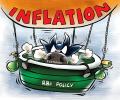
"We have to stand in readiness to go beyond keeping Arjuna's eye to deploying policy instruments, if necessary" to contain inflation, said Reserve Bank Governor Shaktikanta Das on Thursday. Headline consumer price index-based inflation projection for the second quarter of 2023-24 has been revised up substantially, primarily due to the price shock from vegetables, at 6.2 per cent by the RBI form 5.2 per cent estimated in June. Unveiling the bi-monthly monetary policy, Governor Das said the moderation in headline inflation to 4.6 per cent in the first quarter of 2023-24 was in line with the projections set out in the June MPC meeting.

Moody's Investors Service on Thursday downgraded subordinated debt ratings of 11 Indian banks, including SBI, ICICI Bank and HDFC Bank.
The Reserve Bank of India (RBI) will maintain the policy repo rate at 6.5 per cent during its upcoming June 8 announcement, considering the easing of retail inflation in April and the potential for further decline, indicating the effectiveness of previous policy rate actions, anticipate experts. Headed by Reserve Bank Governor Shaktikanta Das, a meeting of the six-member Monetary Policy Committee (MPC) is scheduled for June 6-8. The decision of the 43rd meeting of the MPC would be announced on Thursday, June 8.

Improved monsoon, solid fiscal performance, and capex push by the public and private sectors augurs well for India's macroeconomic stability and growth, the finance ministry's monthly economic review for June 2023 said. But the report said that while India's domestic fundamentals remain strong, negative cross-border spillovers and adverse global developments could act as a deterrent in achieving the high growth path this financial year. "An improved matching of aggregate supply and aggregate demand in the Indian economy underpins the progress made in the control of domestic inflation and the consequent strengthening of macroeconomic stability," the review said.

The reason why private banks will play the deposit pricing game strategically is the weakening of banks' deposits base given the competition from MFs and insurance companies due to tax-savings schemes.

Prime Minister Narendra Modi on Saturday announced the adoption of the New Delhi Leaders Declaration, a significant victory for India's G20 presidency that came amid increasing tensions and divergent views over the Ukraine conflict.

Money parked by Indians in Swiss banks rose over 50 per cent to CHF 1.01 billion (Rs 7,000 crore) in 2017, reversing a three-year downward trend amid India's clampdown on suspected black money stashed there.

'A key reason for the strong interest in IPOs has been an increased focus on profitability and reasonable pricing of deals.'

With a loan book of $268 billion, India's retail banking is now ahead of Russia, Malaysia and Mexico but behind China, Brazil and Thailand

While payments banks surely lose money, their operating ratios were looking better in 2017-18 compared to the year before. This implies that as customer volumes start picking up, the business models may perk up too, says R Jagannathan.

Companies don't have to be in the field to nudge people to return money they owe lenders.
